Baek Seok · Poems of the North / Read & listen

Noodle Soup

국수

A winter meal, carrying a village with it.

Snow gathers outside. Inside, steam, scent and memory make the arrival of noodle soup feel larger than a meal.

Poem by Baek Seok · English translation by Peter N. Liptak
Published edition, pp. 218–221

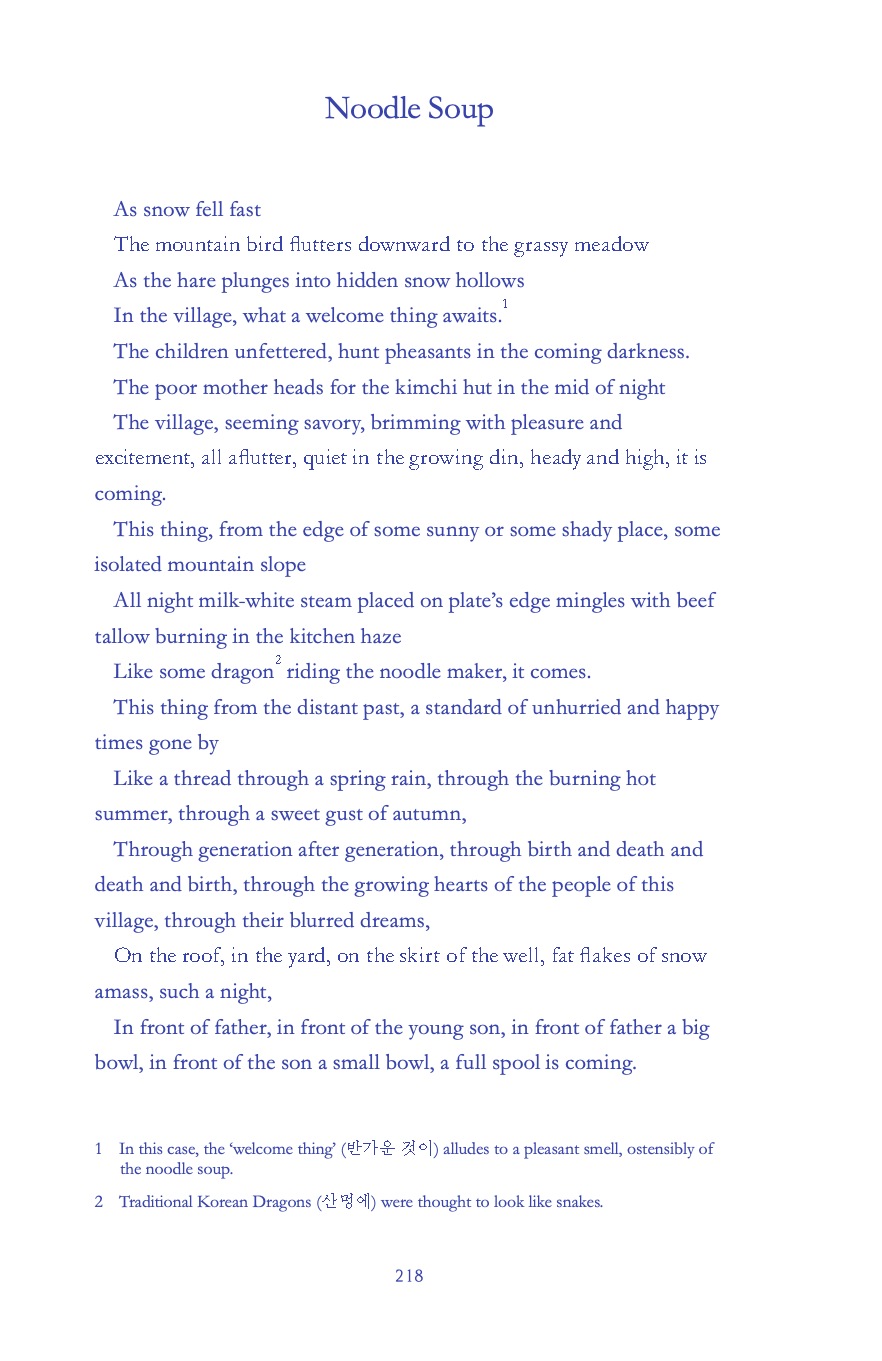
Noodle Soup: published page 218Noodle Soup: published page 220
The published pages · Select a page to enlarge it.

The published text

English

As snow fell fast The mountain bird flutters downward to the grassy meadow As the hare plunges into hidden snow hollows In the village, what a welcome thing awaits.1 The children unfettered, hunt pheasants in the coming darkness. The poor mother heads for the kimchi hut in the mid of night The village, seeming savory, brimming with pleasure and excitement, all aflutter, quiet in the growing din, heady and high, it is coming. This thing, from the edge of some sunny or some shady place, some isolated mountain slope All night milk-white steam placed on plate’s edge mingles with beef tallow burning in the kitchen haze Like some dragon2 riding the noodle maker, it comes. This thing from the distant past, a standard of unhurried and happy times gone by Like a thread through a spring rain, through the burning hot summer, through a sweet gust of autumn, Through generation after generation, through birth and death and death and birth, through the growing hearts of the people of this village, through their blurred dreams, On the roof, in the yard, on the skirt of the well, fat flakes of snow amass, such a night, In front of father, in front of the young son, in front of father a big bowl, in front of the son a small bowl, a full spool is coming. This thing, as if that great grandma who rode the bear’s back, the bear who had raised her, As if she that stood and sneezed on that straw mat when he heard from that village over the mountain, from that distant time as if that great grandpa that raced to her side,3 it comes. This pale, soft, plain, subtle thing, what is it? On this winter night, with impeccably ripened radish-water kimchi, with that beautifully biting red-pepper powder, with that flavorful fresh pheasant

And that smell of smoke, that smell of vinegar, and that smell of boiled beef boiled in beef broth, the smell that fills the reed-matted room with the spit and seethe of boiling, that warm welcoming spot near the fired floor, what is that?

This tranquil village, this village of well-mannered inhabitants, this close-knit place, what is it? This unquestionably classy but simple thing, what is this?

1 In this case, the ‘welcome thing’ (반가운 것이) alludes to a pleasant smell, ostensibly of the noodle soup.

2 Traditional Korean Dragons (산멍에) were thought to look like snakes.

3 This story of the great grandpa (먼 옛적 큰아버지) comes from an old Korean fable.
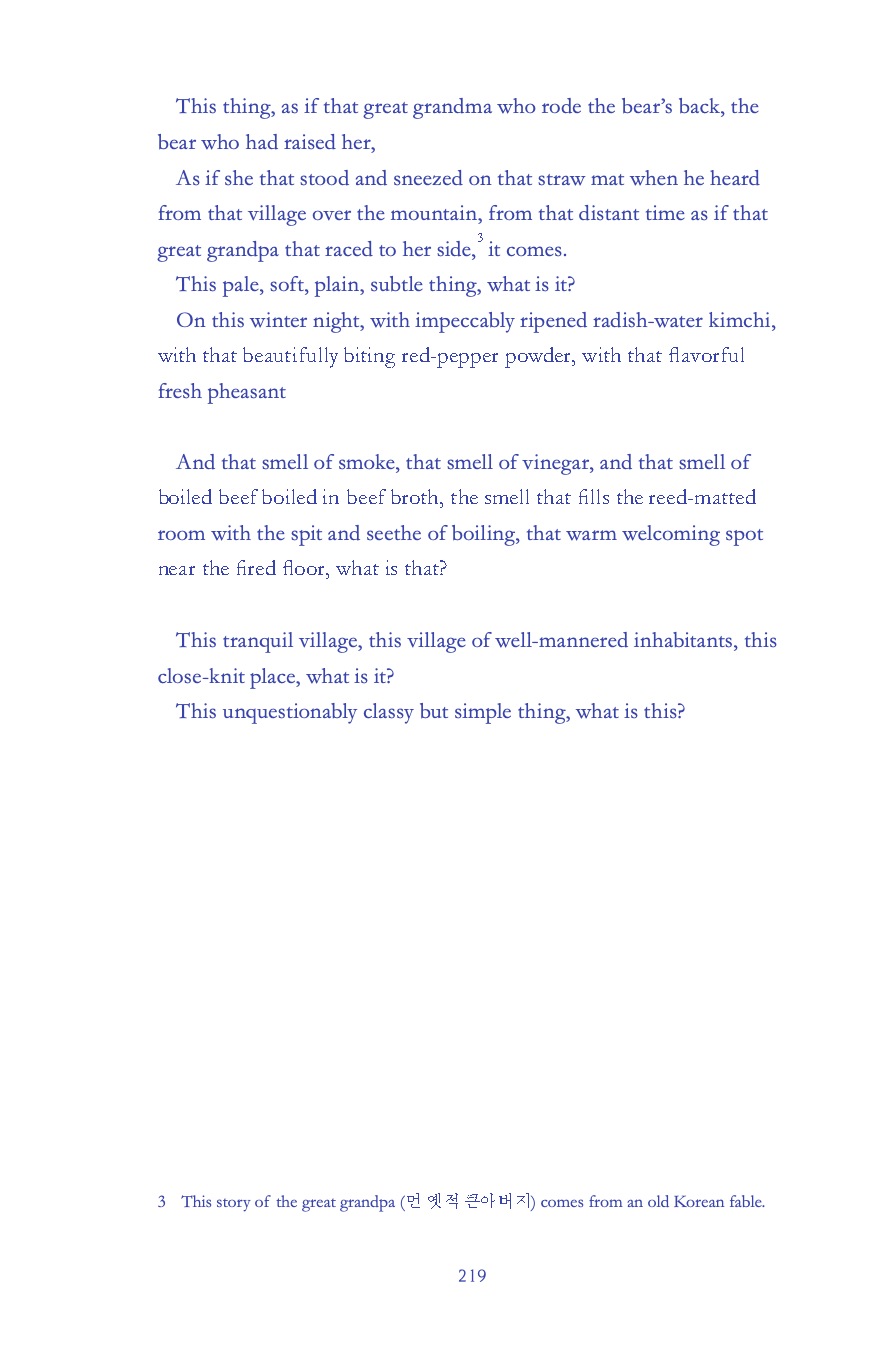
Published notes, pp. 218–219.

한국어

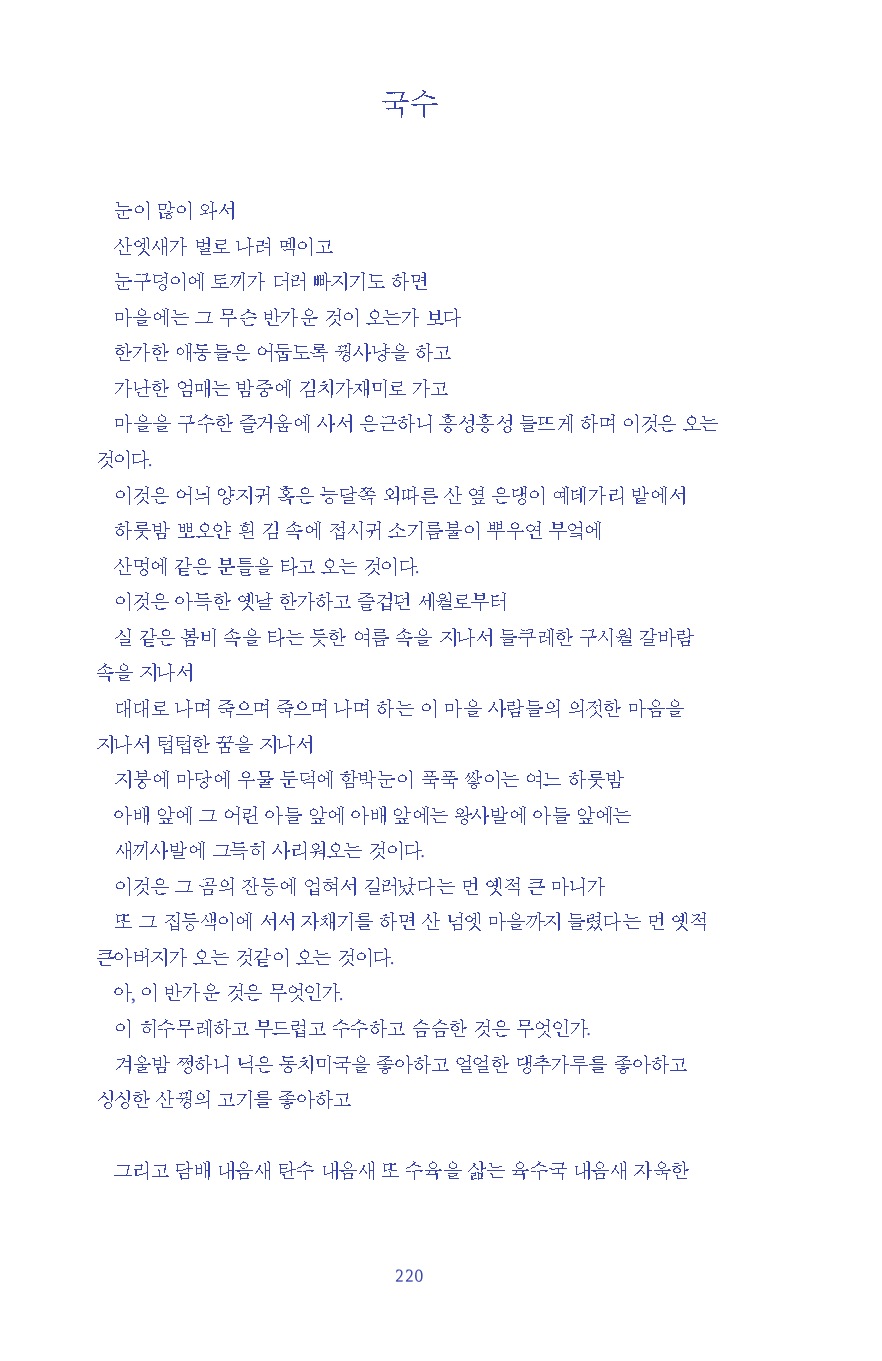
눈이 많이 와서 산엣새가 벌로 나려 멕이고 눈구덩이에 토끼가 더러 빠지기도 하면 마을에는 그 무슨 반가운 것이 오는가 보다 한가한 애동들은 어둡도록 꿩사냥을 하고 가난한 엄매는 밤중에 김치가재미로 가고 마을을 구수한 즐거움에 사서 은근하니 흥성흥성 들뜨게 하며 이것은 오는 것이다. 이것은 어늬 양지귀 혹은 능달쪽 외따른 산 옆 은댕이 예데가리 밭에서 하룻밤 뽀오얀 흰 김 속에 접시귀 소기름불이 뿌우연 부엌에 산멍에 같은 분틀을 타고 오는 것이다. 이것은 아득한 옛날 한가하고 즐겁던 세월로부터 실 같은 봄비 속을 타는 듯한 여름 속을 지나서 들쿠레한 구시월 갈바람 속을 지나서 대대로 나며 죽으며 죽으며 나며 하는 이 마을 사람들의 의젓한 마음을 지나서 텁텁한 꿈을 지나서 지붕에 마당에 우물 둔덕에 함박눈이 푹푹 쌓이는 여느 하룻밤 아배 앞에 그 어린 아들 앞에 아배 앞에는 왕사발에 아들 앞에는 새끼사발에 그득히 사리워오는 것이다. 이것은 그 곰의 잔등에 업혀서 길러났다는 먼 옛적 큰 마니가 또 그 집등색이에 서서 자채기를 하면 산 넘엣 마을까지 들렸다는 먼 옛적 큰아버지가 오는 것같이 오는 것이다. 아, 이 반가운 것은 무엇인가. 이 히수무레하고 부드럽고 수수하고 슴슴한 것은 무엇인가. 겨울밤 쩡하니 닉은 동치미국을 좋아하고 얼얼한 댕추가루를 좋아하고 싱싱한 산꿩의 고기를 좋아하고

그리고 담배 내음새 탄수 내음새 또 수육을 삶는 육수국 내음새 자욱한 더북한 삿방 쩔쩔 끓는 아르굳을 좋아하는 이것은 무엇인가.

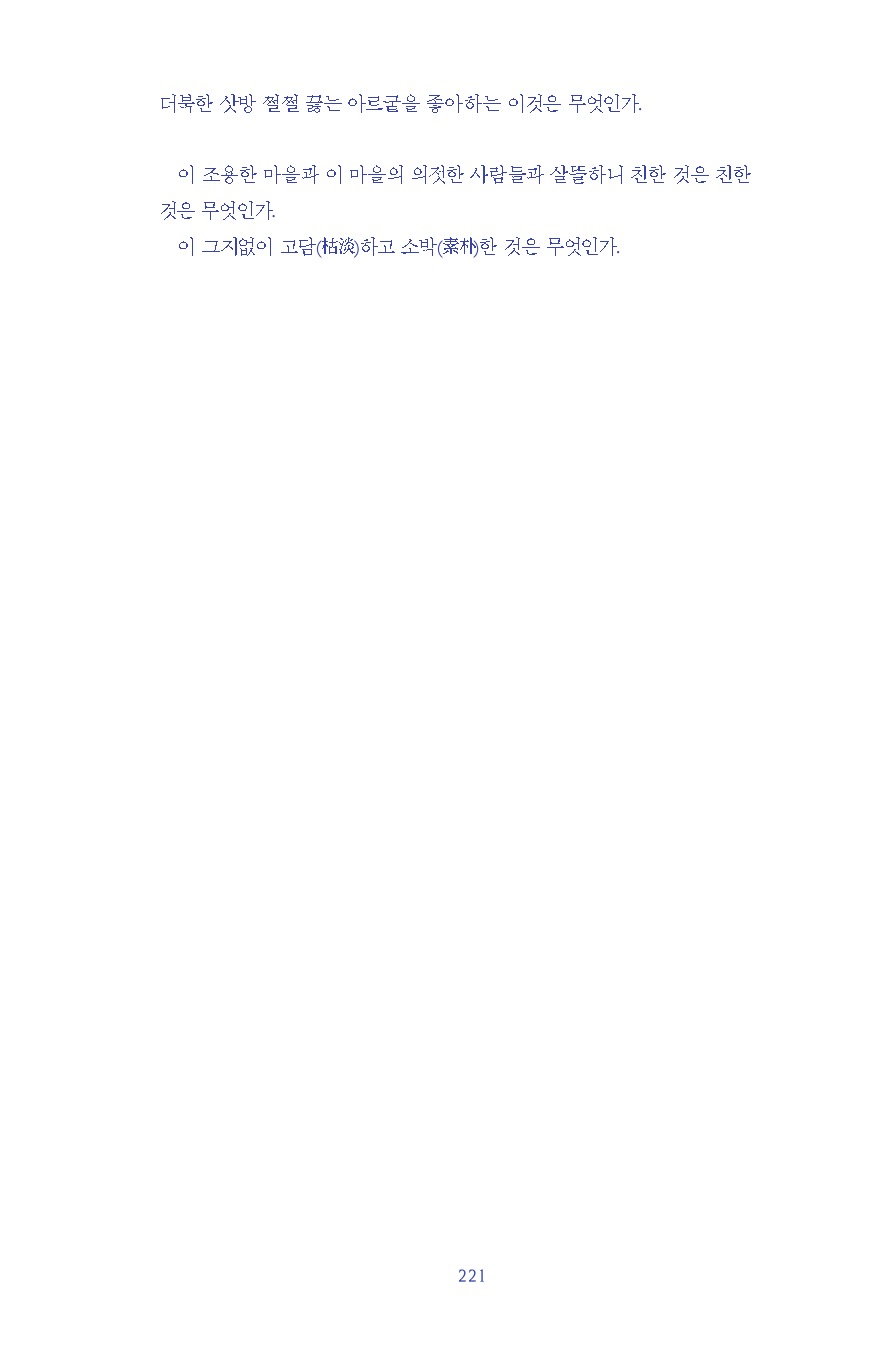
이 조용한 마을과 이 마을의 의젓한 사람들과 살뜰하니 친한 것은 친한 것은 무엇인가. 이 그지없이 고담(枯淡)하고 소박(素朴)한 것은 무엇인가.

Wording, punctuation and stanza divisions follow the published pages. Line wrapping adapts to your screen.

Hear the original

Listen to the Korean.

Korean reading by Hojae Kim. Follow the Korean text, then return to the English.

See the original book pages
Published English translation, page 218, of Noodle SoupPublished Korean original, page 219, of Noodle SoupPublished Korean original, page 220, of Noodle SoupPublished Korean original, page 221, of Noodle Soup

Original page reproductions. Select a page to enlarge it.

A thing arriving

The poem keeps announcing that something is coming before asking what it is. The title gives us an answer, but the unfolding scene makes that answer richer: a meal carries work, family, seasons and remembered lives into the room.

From weather to the table

Birds and hares respond to the snow; children hunt, and a mother goes to the kimchi hut. The poem moves between outdoor cold and the warmth of a kitchen. Read the smells beside the movement of the snow, then notice how the father’s large bowl and the son’s small bowl bring the scene close.

Memory in the making

Spring rain, summer heat and autumn wind enter a winter-night poem. Generations appear alongside the ingredients and the noodle maker. Liptak’s earlier “The Palatal Poems of Baek Suk” research offers a useful context for this attention to food and the ordinary objects through which a remembered world takes shape.

Stay with the questions

The ending asks what this plain, subtle thing is. Return to the repeated questions without replacing them with a single explanation. How does a familiar food become a way of approaching the people and the place around it?

Sources & credits

Poems by Baek Seok. English translation by Peter N. Liptak. Korean reading by Hojae Kim. Artwork in the printed spreads by Choi Joongwon.

Text: Baek Seok: Poems of the North (Exile Press, 2018), pp. 218–221. Context draws on the edition’s “About the Author” (pp. 6–9), “The Palatal Poems of Baek Seok” and introduction (pp. 14–18), and chronology (pp. 316–323), alongside Liptak’s earlier research manuscript, The Palatal Poems of Baek Suk.

The reading notes are new editorial commentary based on those sources. They are not additional quotations from Liptak or a revision of his translation.

Explore Baek Seok’s life →
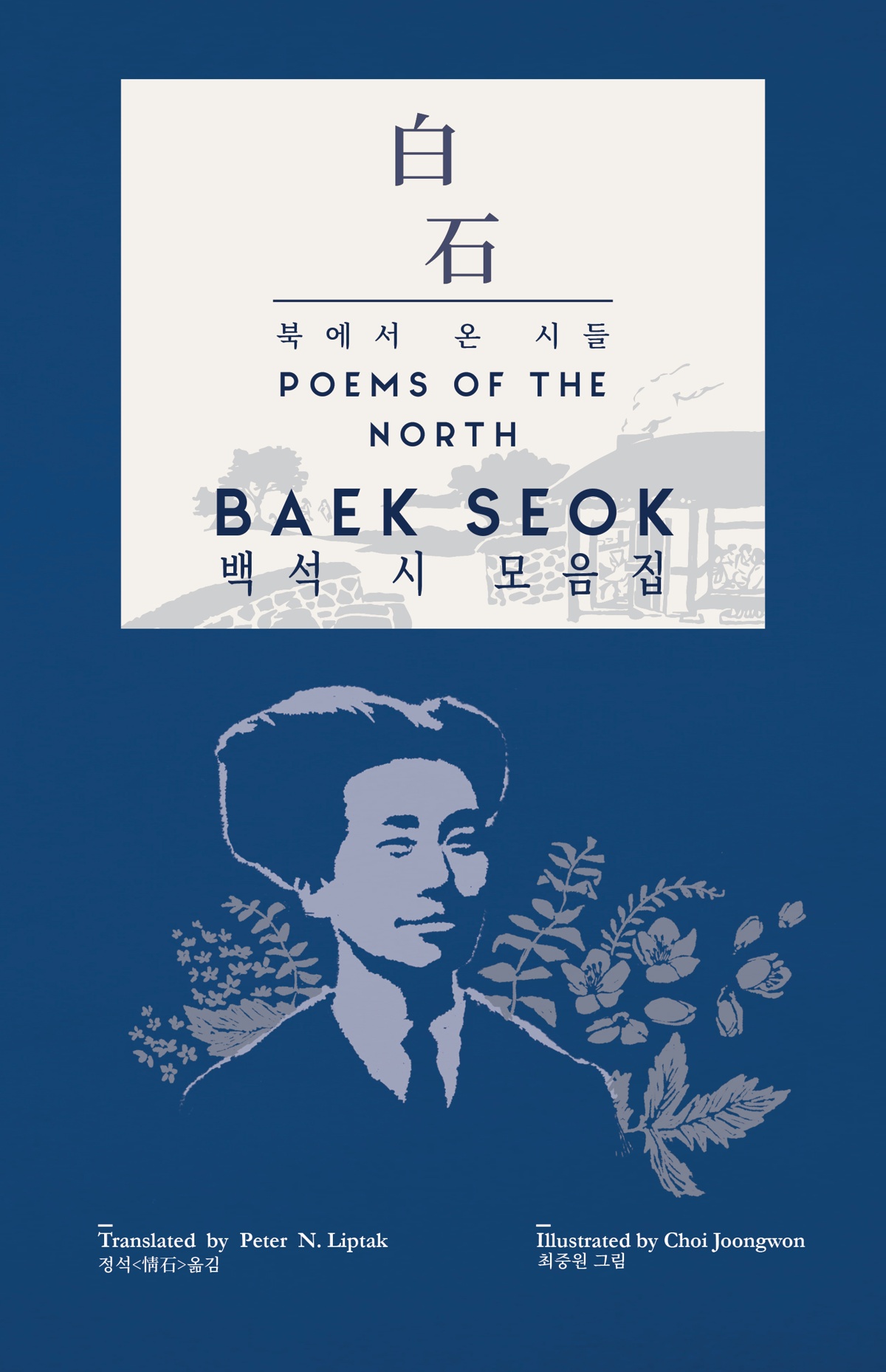
Complete front cover of Baek Seok: Poems of the North

The complete edition

Keep reading.
In both languages.

324-page illustrated hardcover. Korean originals and English translations by Peter N. Liptak, with artwork by Choi Joongwon.

Buy the hardcover · $28.95 ↗

Order directly from Exile Press on Shopify. Shipping and applicable tax shown at checkout.